Alguien escribió:
Voy a incluir un filtro pasa altos a 20Hz para evitarlo.
Muy buena idea.
Alguien escribió:
Podemos ver cómo trabaja mejor con el proyecto a 88.200Hz que a 44.100Hz
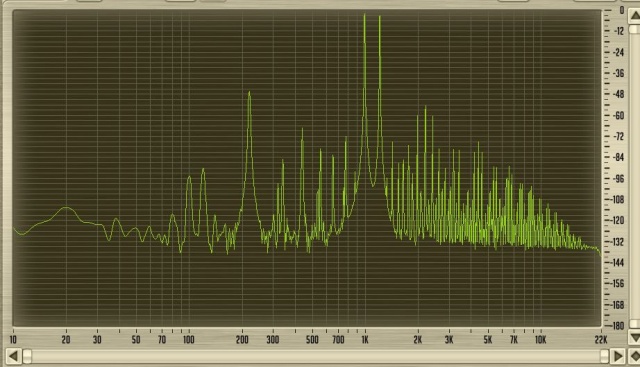
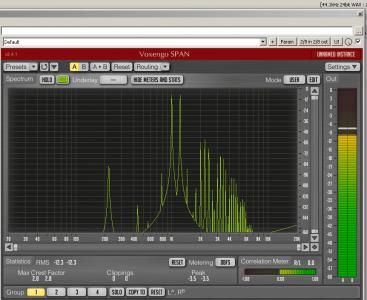
Ojo... 20KHz es múltiplo de 48KHz..... haz la prueba con una senoide que no sea múltiplo.... prueba con 19220Hz por ejemplo, o cosas así....
En cuanto a las pruebas de intermodulación.... te dejo cómo hacerlo según normativas.
DIN-SMPTE: The test signal is a low frequency
(60 Hz) and a non-harmonically related high
frequency (7 kHz) tone, summed together in a 4:1 amplitude
ratio.
IMD-ITU: The common test signal is a
pair of equal amplitude tones spaced 1 kHz apart. Nonlinearity
in the unit causes intermodulation products
between the two signals. These are found by subtracting
the two tones to find the first location at 1 kHz,
then subtracting the second tone from twice the first
tone, and then turning around and subtracting the first
tone from twice the second, and so on. Usually only the
first two or three components are measured, but for
the oft-seen case of 19 kHz and 20 kHz, only the 1 kHz
component is measured
Otra opción es que las hagas con 1KHz y 1220Hz como las hago yo. A mí no me gusta la DIN porque la fecuencia baja hace de transportadora.... y no sale toda la distorsión que luego sale cuando usas música, con frecuencias más cercanas.... y tampoco me gusta la IMD porque porque al igual que la que haces tú, se solapan los armónicos de una señal con los de la otra....