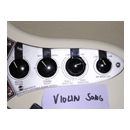
por cierto, por aquella afirmación mía que le dio tanta risa a alguno sobre lo de saturar el Api:
extraido de Gearslutz, esto es lo que dice nada menos que Geoff Tanner, uno de los responsables del sonido Neve y actual jefazo de Aurora audio, todo un experto en el tema sobre lo da saturar los previos:
"Any pre, not just the MA5, should be operated with the output level pot at, or very near, full clockwise rotation.
The more you turn a pot back from maximum, the more you have to crank up the gain to overcome the forced attenuation... so already the amp has 6dB less headroom and 6dB more noise (or thereabouts).
Try the test again with the pot at maximum and set the gain switch for an output of around -16dBf at the most
I come from another era and another style of recording. Nowadays there's a notion that the hotter you record something to digital, the better it will sound. This may be correct in a mathematical world, the crunching of 1's and 0's, (or hexadecimal or whatever goes on inside the box!) but you leave very little digital or analogue headroom".
fuente:
http://www.gearslutz.com/board/high-end ... -ears.html
Aunque está hablando del Avedis, la consulta era sobre lo de atenuar la salida del previo y aumentar su ganancia. A esto, Tanner responde que no entiende esa forma de usar los previos ya que no se construyen ni se diseñan para tales fines.
Si el Api estuviera hecho para ser saturado incluiría un gain y un output, y no se regularía el control de ganancia a la vez que el control de salida.
Eso no implica que no pueda sonar bien en momentos puntuales si eso es lo que se busca, pero como dice Tanner, saturar la ganancia del previo solo aporta mayor ruido de fondo y menor headroom.
Los previos están hechos para usarse limpios, aunque a veces suenen bien si los saturamos, pero como efecto puntual, no como norma.
El sonido Api no implica altos niveles de ganancia en ningún caso. Otra cosa es que a uno le guste.





 , has puesto un huevo. Pero no te preocupes que lo haré. Como hago siempre.