#146
Hola El ruiseñor del Foro,
Tonmeister se traduce en ingles como sound master literalmente y en castellano por Ingeniero de sonido en vez de por maestro de/en sonido que es lo que significa sound master
De hecho
tonmeister viene de
TON - sonido
MEISTER- Maestro/experto
Y dicha carrera se parece a una ingeniera a la española como un Huevo a una castaña.
La primera gran diferencia entre ambas es la proporción o impacto entre teoría y practica.
mientras en la ingieneria de sonido a la española la practica ocupa un papel claramente secundario en el Tonmeister es justo al contrario siendo la practica real algo primordial y troncal estando el alumno de dicho tonmeister obligado a presentar al final de su educación una colección variada de grabaciones realizadas por el alumno de todo tipo y estilo desde la música clásica al rock pasando por cine o tv.
Esto se ve reflejado en algo tan básico como las instalaciones donde el alumno va a cursar sus estudios...
Este es el estudio 1 de surrey destinado principalmente a grabaciones de música clásica :
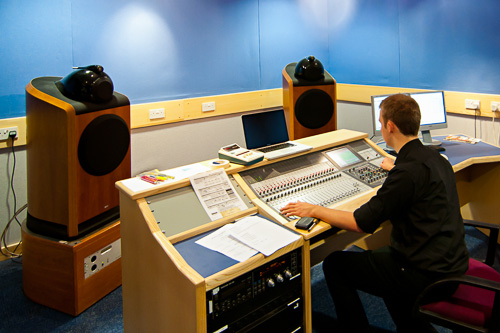
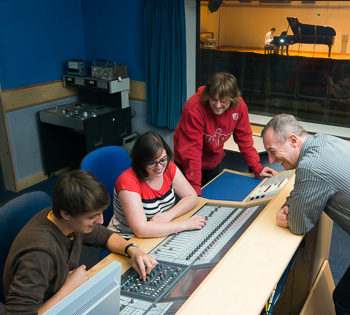
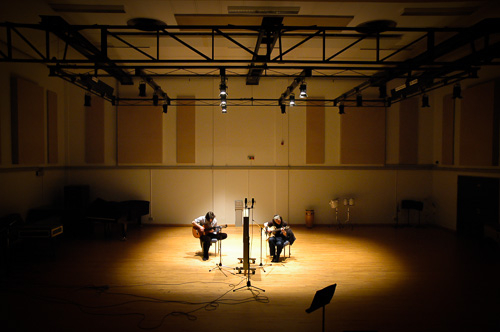
Como se puede ver en la imagen un estudio que dispone de una sala de grabaciones de gran capacidad donde es posible grabar toda una orquesta por ejemplo y que también puede utilizarse para conciertos en directo que los alumnos deberán de grabar, etc....
su equipamiento esta elegido escrupulosamente siguiendo criterios destinados a que el alumno maneje equipos representativos de lo que después el alumno se encontrara en estudios de primer nivel de todo el mundo para realizar ese mismo tipo de trabajo
Y claro esta, cuenta con un diseño acústico a la altura, realzado por un prestigioso diseñador que a su vez a realizado el diseño acústico de algunos de los mas importantes estudios británicos
Alguien escribió:
The control room acoustics were designed by Nick Whitaker (whose other work includes Angel, British Grove and De Lane Lea). The equipment has been selected because it is representative of that used in classical recording. It includes a 48-channel Sony DMX-R100 console, Lexicon 480 reverberation, B&W Nautilus 801 monitoring, and the Pyramix digital recording / editing system. Hence, the control room can be used for recording to stereo or multitrack formats, for multitrack editing, or for mixing pre-recorded sessions.
por si no fuera ya apabullante este estudio para estudiantes, veremos que además hay otros dos estudios principales mas tres salas de edición y por supuesto una sala de escucha diseñada bajo el estándar ITU BS-1116 (hay que joderse estos de surrey parece que a diferencia del profesorado español de acústica si saben diferenciar entre una sala de escucha y una sala de control y para que sirve la recomendación ITU BS-1116 y donde es de aplicación
](https://statics.soniccdn.com/images/smilies/eusa_wall.gif "](*,)")
)
Sin contar claro esta 16 estaciones digitales de trabajo equipos móviles y furgonetas para grabación en localización etc, etc,etc,... o claro esta una colección de microfonia que quita el hipo

Asi por ejemplo nos encontramos que el estudio dos de tamaño mas reducido que el uno y destinado a música pop y rock dispone de una SSL 9000K
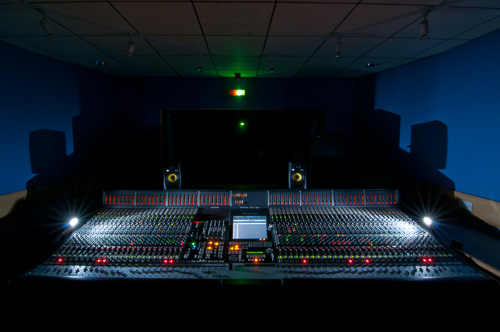
Una vez mas dicho estudio ha sido construido y equipado basándose en los mas altos estándares de la industria de la grabación:
Alguien escribió:
Studio 2 has been designed predominantly for 'pop' recording. The studio floor is acoustically treated to be 'deader' than Studio 1, to limit the recorded reverberation and to allow for greater separation between the instruments. This allows greater flexibility and creativity when it comes to mixing tracks recorded here. It is 60 square metres, which is sufficient to record a large band (in fact 20-piece big bands have been recorded in there).
The control room is designed to be typical of a pop studio. The acoustics have been designed by Nick Whitaker (whose other work includes Angel, British Grove and De Lane Lea). The hub of the studio is a 56-channel SSL 9000K series console (the likes of which you'll also find in Abbey Road Studio 3, Metropolis Studio A and Real World Studios).
Students can record to a range of recording devices in studio 2, including an Otari 2" 24-track analogue tape machine with Dolby SR, a 48-track Tascam hard disk recorder, or to ProTools HDX or Logic. This room also includes Lexicon 480 reverberation, a range of outboard processing equipment, ATC SCM100 monitoring, and stereo digital (DAT & CD) recorders.
Y por ultimo nos encontramos el estudio 3 destinado principalmente a la mezcla de sonido tanto para música como para cine/multicanal
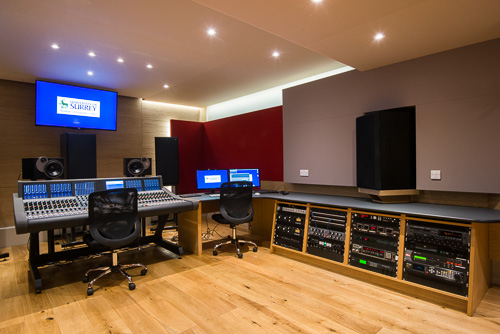
El equipamiento una vez mas de esta sala así como el diseño acústico es equiparable al de instalaciones de primer nivel
Alguien escribió:
Studio 3 is used primarily for mixing recordings made in the other studios. However, it has a small overdub room for adding additional parts to recordings, and has connections to all the other studios so that recordings can be made directly from any of these facilities.
The studio was refitted in the summer of 2013, with an acoustic redesign by John Flynn and Sam Toyoshima of Acoustics Design Group (whose other work includes Abbey Road and SARM West studios).
The refit included a new console - an AMS-Neve 88D was chosen for its high quality and similarity to a range of consoles commonly used in industry. The control surface, processing modules, and internal architecture are similar to the AMS-Neve DFC Gemini consoles that are commonly used in high-end dubbing theatres for film sound (such as De Lane Lea, Goldcrest, and Skywalker Sound). The automation is similar across all AMS-Neve consoles, such as the 88RS (found in Abbey Road, Air Lyndhurst, Sphere, and Ocean Way studios).
The studio is set up for mixing in stereo and 5.1 surround sound, and includes a 5-channel ATC monitoring system with Genelec subwoofer.
There is a range of outboard processing in this studio, including Bricasti, Focusrite, SSL, Thermionic Culture and TC Electronic units. There is a Studer A80 2" 24-track analogue tape recorder with Dolby SR to allow transfer of material from Studio 2 as well as an Apple Mac Pro running ProTools HDX and Apple Logic (with 48 MADI i/o channels). Pyramix is also available to enable mixing of work recorded in Studio 1.
Si miramos las salas de edición también veremos que no están realizadas de cualquier forma ni equipadas sin pensar en una aplicación real dentro de la industria empleando equipamiento estándar
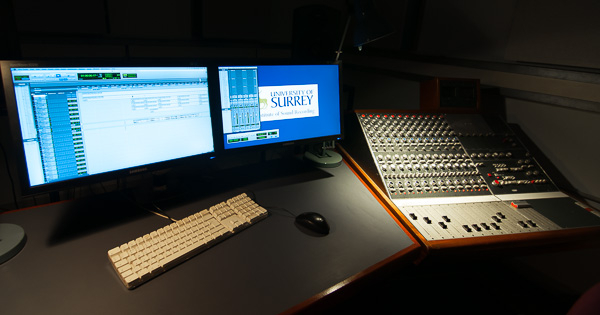
Alguien escribió:
The edits rooms are used for a wide range of audio post-production tasks.
Studio recordings of classical music are usually made up of a number of takes, that are later edited together. All three edit rooms have Pyramix Native, which is designed specifically for this type of work.
Increasingly, pop music recordings involve significant editing, from correcting the timing of rhythm parts, to tuning vocals. In addition, students often mix at home using their own DAW systems such as Pyramix, ProTools or Logic. To enable this type of work, all three edit rooms have Pyramix Native, ProTools Native and Logic, and edit rooms 1 and 2 have fader controllers to assist with mixing.
The edit rooms are also frequently used for post-production audio work for film and TV. This includes sound effects and Foley editing, speech editing and ADR fitting, and creation of pre-dubs. One example of this is the audio post-production coursework which involves editing the location sound and ADR from a pre-recorded television shoot, and adding appropriate music and effects.
In addition to these facilities, edit 3 houses a 12-channel Neve Melbourn console, which allows mixing of tracks or stems via a classic analogue console, as well as a range of 2-channel recording and replay devices such as 1/2" analogue reel-to-reel, cassette, DAT, and CD recorders, and a Technics turntable. Edit 3 also includes a SADiE DAW, commonly used for mastering and editing for broadcast.
Especial mención tiene la sala de escucha
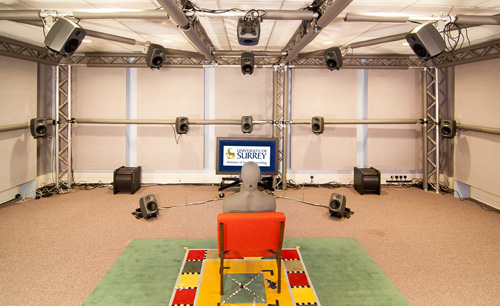
Alguien escribió:
The ITU-R BS.1116 critical listening room and audio laboratory (designed and built by Munro Associates) are used by students and researchers to undertake experimental work involving audio measurement and subjective listening tests.
Donde demuestran que el centro formativo esta no ya preparado en sus instalaciones si no que sus dirección y profesorado son realmente profesionales con experiencia y que saben perfectamente donde es aplicable dicha norma ITU-R BS.1116 y cual es la aplicación real de dicho tipo de salas de escucha (que no salas de control) y cuales son las limitaciones de dichos estándares en la practica a la hora de ser aplicados en el diseño de una sala de control
De hecho hay otro sitio en su pagina web donde esto queda palpablemente demostrado :
Alguien escribió:
A question of specification
There are various standards that specify the acoustics of listening spaces. For instance, IEC 268-13 attempts to be representative of a domestic listening space, and specifies the room dimensions, reverberation time, and background noise levels. Another example is ITU-R BS 1116, which is a more critical specification, and specifies room size, background noise, room proportions, reverberation time, frequency response, early reflections, and late energy characteristics. However, even rooms that meet these specifications can sound very different. Our listening room meets ITU-R BS 1116, principally using absorption. I've also experienced another listening room that meets the same specification mainly through the use of diffusion instead. They both meet the specification, but they sound very different.
So the first difficulty is how you specify a room: what factors are important, and what specification should it meet? At the moment, there is no 'ideal' specification, and there are certain things that we measure to characterise a room, but these don't cover all relevant aspects of our perception, and aren't directly related to what we perceive.
A set of compromises
The optimisation of the acoustics of small rooms is a complex topic. Unlike large room acoustics, ray-based analysis isn't relevant for a significant fraction of the frequency range. Instead, we're dealing with modal responses that can be more difficult to predict. There are also many factors to play off against each other, and partial treatment can sometimes make things subjectively worse.
Take, for example, a single reflective surface. If this surface produces a perfect specular reflection (like a mirror), then the combination of the direct sound and reflection at the listening position will cause comb filtering (a series of cancellations at frequencies that are numerically related). These cancellations each will cover a very narrow frequency range, with the spacing between them determined by the time of arrival difference between the direct and reflected sound.
If the surface is now treated (using absorption or diffraction), the amount of cancellation can be reduced (the 'depth' of the notch will be less). However, this will often be at the expense of 'widening' the notch. So what is worse, a narrow and deep notch, or a shallow and wide notch? The answer is probably: 'it depends'.
A question of experience
So how does an acoustician deal with all of this complexity and compromise? A good understanding of acoustic theory is obviously important. But experience is also essential. Over years of designing studios, an acoustician can refine their techniques, identify likely solutions to problems, and also learn from their mistakes. As one experienced acoustician told me: "the acceptance testing at the end is not for this project's benefit, but so I can learn for future projects".
It's likely to be because of this combination of complexity, compromise, and experience, that acousticians seem to rely on tried and tested overall design types. One may favour absorption at the front of the room, and diffusion at the back of the room. Another may favour directing early reflections away from the listening position. Another may favour a reflective front part of the room and increasing absorption towards the back of the room. Yet another may favour significant absorption all round.
Si comparamos este texto con las respuestas de algunos profesores universitarios, de acústica españoles, que pululan por este mismo foro nos podemos dar cuenta rápidamente que mientras en la universidad de surrey tienen una conocimiento y experiencia real basado no ya solo en la teoría si no en la puesta en practica de todas estas cuestiones, nuestro profesor español, conoce perfectamente la teoría, confunde algunos aspectos que no logra comprender por falta de experiencia, y se equivoca estrepitosamente en la practica.
También esto es algo normal y previsible ya que mientras es evidente que los encargados del centro de Surrey tienen contacto permanente con un mundo real de primer nivel los profesores españoles y directores de centro en el mejor de los casos lo conocen por libros revistas y foros como hispasonic o similares donde alumnos de esas ingenieras españolas se convierten en verdaderos totems de foro gracias a una verborrea técnica sin parangón y a un desconocimiento practico que raya el esperpento.
Posiblemente la responsabilidad sobre su desconocimiento no tenga mucho que ver con su interés si no con haber nacido en un país donde esto no es visto por la sociedad ni tan siquiera como una profesión (al menos digna)
Y a que sus centros formativos están muy lejos de estándares como los del Tonmeister europeo
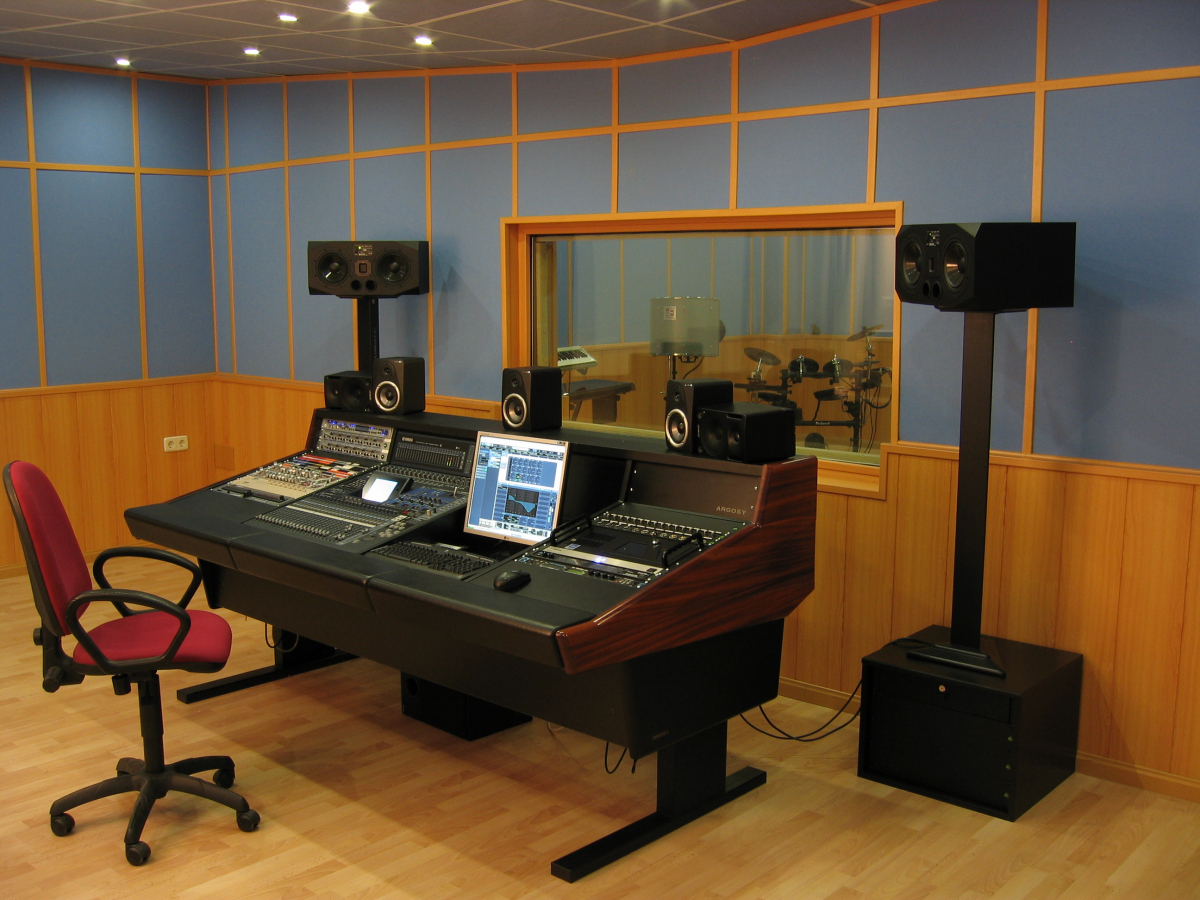
Cuando veo el estudio de grabación de la Escuela Técnica Superior de Ingeniería y Sistemas de Telecomunicación de la Universidad Politécnica de Madrid, desde luego no lo identifico con ningún estándar internacional pero si con un despropósito tipo medio hispasonico donde se puede ver friso en las paredes o altavoces en posiciones que denotan un desconocimiento de las mas mínimas normas que rigen su instalación y funcionamiento.
Sin contar que la vision de una batería electrónica en la sala de grabación es toda una declaración de intenciones sobre que tipo de instrumentos van dichos alumnos a poder grabar si es que terminan grabando algo con algún mínimo fundamento.
De esto es de lo qu eme quejo de esto y de que mientras el alumno de surrey después de una formación envidiable que realmente le ha preparado para trabajar en una industria real y altamente competitiva su objetivo sera entrar como asistente en algún estudio de grabación puntero internacional posiblemente trabajando gratis (en el mejor de los casos) con el objetivo de llegar algún día a ser un ingeniero de sonido nuestro alumno de enseñanza a la española saldrá convencido de que es un autentico Ingeniero de sonido porque tiene un titulo en su pared que así lo dice y esperara que al entrar en un estudio de grabación le traten como su titulo demanda

Si quieres profundizar en la humillación que supone comparar ambos centros formativos y la orientación de dicha formación, planes de estudio, temario, etc, etc, etc,.... te dejo el enlace de ambos centros formativos :
http://www.tonmeister.co.uk/index.php
http://www.etsist.upm.es/estudios/grado/sonido_imagen
Un saludo







 ).
).